Professional-Grade Meat Thermometers: Are They Worth the Investment?
An honest breakdown of whether professional-grade meat thermometers are worth the cost. Covers accuracy specs (±0.7°F vs ±4°F budget models), response time, real cost math, precision techniques where it matters, and when a cheap thermometer is genuinely fine.

The Short Answer
Yes — with conditions. If you regularly cook expensive cuts, chase precision, or compete, a professional-grade thermometer pays for itself after one saved prime rib. If you grill burgers and chicken thighs on weekends and don't mind the occasional overcooked steak, a $20 thermometer does the job. The honest answer isn't "everyone should spend $150 on a thermometer." It's "know what you're cooking and how much it costs when you get it wrong."
What "Professional-Grade" Actually Means
The word "professional" gets slapped on a lot of products that are just slightly nicer versions of the cheap ones. With thermometers, there are actual, measurable differences — not marketing language.

Accuracy
Budget thermometers typically read within ±2–4°F of the actual temperature. That sounds small until you realize a 4°F swing on a medium-rare steak is the difference between 131°F (perfect) and 135°F (medium). Professional models — think ThermoWorks Thermapen, Javelin Pro, or high-end DOT probes — are rated at ±0.7°F or better. That's not a marketing number. It's a calibrated, NIST-traceable spec.
At the extremes — candy at 300°F or deep frying at 375°F — that accuracy gap gets even more expensive when you get it wrong.
Response Time
Budget thermometers typically take 8–10 seconds to stabilize on a reading. Professional models read in 2–3 seconds. That doesn't sound like a big deal until you're probing six steaks on a hot grill with your hand over a fire. Speed matters in practice, not just on a spec sheet.
Build Quality and Durability
Budget probes bend. Seals fail. Displays fog up. Professional thermometers are built to commercial kitchen standards — stainless probes, waterproof housings, and warranties measured in years instead of "we'll see." The internal components are tighter, the calibration holds longer, and the thing doesn't die when it falls off a table onto concrete. Which it will.
| Feature | Budget ($15–30) | Mid-Range ($50–80) | Professional ($100–200) |
|---|---|---|---|
| Accuracy | ±2–4°F | ±1–2°F | ±0.5–0.7°F |
| Response Time | 8–10 seconds | 4–6 seconds | 2–3 seconds |
| Waterproofing | None / splash resistant | IP65 (splash proof) | IP67 (submersible) |
| Probe Material | Thin stainless, bends easily | Reinforced stainless | Heavy-gauge, food-grade stainless |
| Warranty | 90 days – 1 year | 1–2 years | 2–5 years |
| Calibration Stability | Drifts over time | Moderate stability | NIST-traceable, long-term stable |
When the Extra Money Pays Off

High-Stakes Cuts
A USDA Choice prime rib runs $80–$120 at the grocery store. A Wagyu brisket can hit $200. These aren't Tuesday night dinners — they're event cooks where the margin for error is close to zero.
When a prime rib needs to hit 130°F for a proper medium-rare, a ±4°F thermometer means you're actually targeting a range of 126–134°F without knowing it. Hit 134°F and you've crossed into medium on a $100 roast. Hit 126°F and you're serving rare at a holiday dinner to your in-laws.
With a ±0.7°F thermometer, you know your 130°F is actually 130°F, give or take less than a degree. Check our BBQ meat calculator to plan quantities for your next big cook.
Competition BBQ players understand this differently. When you're judged on a quarter-inch bite of brisket, the window between "great" and "dry" is maybe 5 degrees. Nobody who competes seriously uses a $20 thermometer. That's not snobbishness — it's just math.
Precision Techniques
Reverse sear is one of the best methods for thick steaks — you bring the internal temp up slowly in a low oven (225–250°F), then finish hot on the grill for crust. The target for pull-from-oven is usually 120–125°F for medium-rare. You're working in a 5°F window on purpose.
A slow response time makes this miserable. You probe, wait 10 seconds, the number's still moving, you probe again, and by the time you get a stable reading you've either pulled it early or talked yourself into "close enough." With a 2-second read, you know immediately, every time.
Smoking brisket over 12–18 hours is another place where accuracy compounds. Use our brisket cook time calculator to plan your timeline, then trust your thermometer for the final call. Small errors in temperature reading over many hours lead to big errors in final texture.
The Stall — Navigating 150–170°F Without Guessing
If you've smoked a brisket, you've met the stall. Internal temp climbs normally, then gets stuck somewhere between 150–170°F for what feels like the rest of your life. It can sit there for 3–6 hours.
The stall is evaporative cooling — moisture leaving the meat keeps the surface temperature stable despite constant heat. It's not a problem, but it requires a decision: wait it out, wrap in butcher paper (the Texas crutch), or adjust your pit temp.
Making that decision well requires knowing your actual internal temp, not an approximation. If you think you're at 162°F but your thermometer reads ±4°F, you're actually somewhere between 158°F and 166°F. That changes your timeline estimate by hours. A ±0.7°F thermometer tells you exactly where you are in the stall, which is the only information you need to make a good decision.
When a Cheap Thermometer Is Fine
This section exists because honest advice means telling you when not to spend money, too.
If your standard cook is burgers, chicken thighs, hot dogs, and the occasional pork chop, a budget thermometer does everything you need. You're checking for "is this done" not "is this exactly 135°F." A $20 thermometer reads 160°F reliably enough. According to FoodSafety.gov's safe temperature guidelines, poultry needs to reach 165°F — plenty of margin on both sides of a ±4°F error.
Beginning grillers are also better served starting cheap. Thermometer accuracy is about number 8 on the list of things to get right when you're learning. Fire management, positioning, resting — get those down first. Upgrade when accuracy becomes the limiting factor, not before.
Well-done cooks — burger at 160°F, chicken breast at 165°F+, fully cooked pork — have enough margin that precision barely matters. You're not threading a needle at 130°F. You're confirming something is cooked through. Any thermometer does that.
The honest version: if you're not regularly cooking expensive cuts, using precision techniques, or competing, spend $20 and put the rest toward better meat.
The Real Cost Math
People resist spending $150 on a thermometer. The same people will spend $120 on a prime rib without hesitating. Let's actually run the numbers.
One ruined prime rib: $90–$120 for the roast. Add in sides, time, the dinner party that went sideways — call it $150 in total damage. One overcooked holiday roast costs more than the thermometer you didn't want to buy.
Budget thermometer replacement cycle: Most $15–30 thermometers last 1–2 seasons with regular use before the probe drifts, the seal fails, or the battery connection gets unreliable. Three years of $25 thermometers = $75 and three rounds of figuring out the new one.
Professional thermometer lifespan: ThermoWorks offers a 2-year warranty and their Thermapen models routinely last 5–10 years with normal use. At $99–$165, the per-year cost over a 7-year life is $14–24 annually. Less than a replacement budget model every year.
The actual math:
- Budget path (3 years): $75 in thermometers + 1 ruined cook at $120 = $195
- Professional path (3 years): $150 thermometer + 0 ruined cooks = $150
The numbers aren't dramatic, but they're real. And they don't account for the value of not standing over a grill at a dinner party wondering if your ±4°F reading is going to hold.
Beyond BBQ
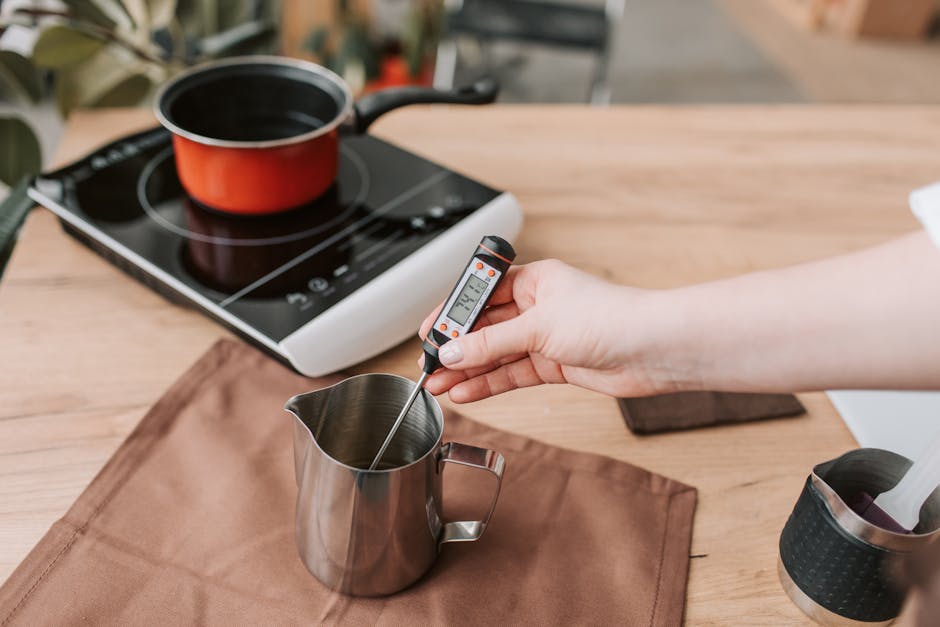
A good thermometer doesn't live only outside. It earns its keep in the kitchen year-round, which changes the cost calculation entirely.
Candy making: Hard crack stage is 300–310°F. Soft ball is 235–240°F. A ±4°F error at those ranges produces wrong-stage candy every time. Precision here isn't optional — it's the difference between toffee and a sticky mess.
Deep frying: Oil at 325°F vs. 350°F produces meaningfully different results on fried chicken. Budget thermometers often have limited range and sluggish response in hot oil. A fast, accurate read means your oil is actually at temperature before you drop food, not approximately at temperature.
Bread baking: Internal temp of 200–210°F tells you a loaf is fully baked regardless of what the crust looks like. Probing bread is a simple, reliable method that removes guesswork — but only if the thermometer is fast enough to give you a stable reading in a dense crumb.
Food safety: The USDA food safety guidelines exist for a reason. If you're cooking for guests with health considerations, serving a crowd, or just want certainty on poultry and ground meat, a thermometer you trust removes doubt. ±0.7°F at 165°F means something. ±4°F means less.
Add all of that up and the "grilling thermometer" becomes a kitchen tool you reach for weekly, not seasonally. The per-use cost gets very small, very fast.
What to Look For When Buying
Not all thermometers above $100 are worth it. Here's what the spec sheet should actually say.
Accuracy Rating (±1°F Minimum)
Any professional-grade claim should come with a stated accuracy specification. If the product page doesn't list it, or lists it as "highly accurate" without a number, skip it. Minimum acceptable is ±1°F. Best in class is ±0.7°F. Look for NIST-traceable calibration if it exists — it means the spec was actually verified against a standard, not just printed on a box.
Response Time (Under 3 Seconds)
Under 3 seconds for a stable reading is the benchmark for professional use. 2 seconds is better. Some high-end models hit 1–1.5 seconds. Anything over 5 seconds on a product marketed as "professional" is a red flag — the sensor is budget-grade regardless of what the housing looks like.
Waterproofing (IP Rating)
IP65 means protected against directed water spray — fine for a kitchen, marginal for outdoor grilling in rain. IP67 means it can be submerged in 1 meter of water for 30 minutes. Grilling thermometers should be IP67 minimum. You're going to wash it, drop it in a sink, or leave it out when the weather turns. "Splash resistant" without an IP number is marketing, not engineering.
Probe Length and Material
Standard probe length is 4–5 inches. For deep roasts or large briskets, 6 inches is more useful. Probe should be food-grade stainless steel — 304 or 316 grade. Thin probes (under 1.5mm diameter) give faster readings but are more prone to bending. Thicker probes are slower but last longer in commercial-style use. See our chicken temperature guide for a real-world example of why probe placement and accuracy matter together.
Warranty
Two years minimum. Five years is better. A manufacturer confident in their build quality offers a real warranty. A 90-day warranty on a $150 thermometer is telling you something about how they expect it to perform.
| Criteria | What to Look For | Red Flags |
|---|---|---|
| Accuracy | ±1°F stated spec, NIST-traceable preferred | "Highly accurate" with no number |
| Response Time | 2–3 seconds to stable reading | Over 5 seconds on a "pro" model |
| Waterproofing | IP67 rated minimum | "Splash resistant" with no IP number |
| Probe | Food-grade stainless, 4–6 inch length | Thin probe with no gauge spec listed |
| Warranty | 2 years minimum, 5 preferred | 90 days or "limited" with no detail |
| Calibration | User-adjustable or factory-verified | No mention of calibration at all |
Common Mistakes People Make
Even a great thermometer gives you bad data if you use it wrong. These are the ones that trip up experienced grillers, not just beginners.
Placing the probe near bone: Bone conducts heat differently than meat. A probe resting against or near bone reads higher than the surrounding tissue. On a ribeye or a leg of lamb, probe placement matters. Insert into the thickest part of the muscle, away from bone, and angle away from fat pockets.
Not waiting for the reading to stabilize: Fast thermometers still need a moment. Pulling the probe out at 2 seconds when it reads 128°F — and the real temp is 131°F because the sensor was still climbing — causes you to keep cooking past your target. Watch the number stop moving, not just appear.
Skipping calibration checks: Even high-quality thermometers can drift. Ice water should read 32°F. Boiling water at sea level should read 212°F. Check yours twice a year. If it's off by more than 1–2°F, recalibrate or replace. A $150 thermometer reading 4°F off is worse than knowing your $20 thermometer reads 3°F high — at least then you've accounted for it.
Testing in the wrong spot: For whole birds, the thigh joint — not the breast — is the slowest-cooking part. For thick roasts, test at the geometric center. For burgers, probe horizontally through the side to reach the center without hitting the grill grate.
The Bottom Line
Buy a professional-grade thermometer if you cook expensive cuts more than a few times a year, use precision techniques, or compete. The accuracy difference is real and it shows up in the food. The cost math works out in your favor faster than you'd expect.
Stick with a budget model if your standard cook is chicken, burgers, and well-done anything. Accuracy at that level matters less than technique and fire management, and the ±4°F error won't cost you much.
If you're on the fence: buy once, buy well. A ±0.7°F thermometer with IP67 waterproofing and a 5-year warranty that you use for grilling, frying, baking, and candy is a $150 kitchen tool spread across a decade of cooks. That's less than a decent bottle of bourbon — and it'll improve more meals.
Frequently Asked Questions
What accuracy should a professional meat thermometer have?
A professional-grade meat thermometer should be accurate to within ±1°F at minimum. Best-in-class models achieve ±0.7°F with NIST-traceable calibration. Budget thermometers typically vary ±2–4°F, which is enough to cross from medium-rare into medium on a steak.
How long does a professional meat thermometer last?
High-quality meat thermometers from brands like ThermoWorks typically last 5–10 years with normal use. Most come with 2–5 year warranties. Budget thermometers ($15–30) usually need replacement every 1–2 seasons as the probe drifts or seals fail.
Is it worth spending more than $100 on a meat thermometer?
Yes, if you regularly cook expensive cuts (prime rib, wagyu brisket) or use precision techniques like reverse sear or smoking. A single ruined $100 roast costs more than the price difference between budget and professional models. If you cook mostly well-done or casual weeknight meals, a $20 thermometer is sufficient.
What is the fastest meat thermometer response time?
Top-tier instant-read thermometers like the ThermoWorks Thermapen One read in approximately 1 second. Professional models generally read in 2–3 seconds. Budget thermometers typically take 8–10 seconds to stabilize, which matters when probing multiple cuts over a hot grill.
What IP rating should a grilling thermometer have?
A grilling thermometer should have at minimum an IP67 waterproof rating, meaning it can be submerged in water up to 1 meter for 30 minutes. IP65 (splash-proof) is acceptable for kitchen use but marginal for outdoor grilling. Any product claiming "splash resistant" without a specific IP number provides no guarantee.
How do I know if my meat thermometer needs calibration?
Test in ice water (should read 32°F) and boiling water at sea level (should read 212°F). If your thermometer is off by more than 1–2°F on either test, it needs calibration or replacement. Check calibration twice per year, especially at the start of grilling season.
Recommended by Titan Grillers
IP67 Waterproof Digital Meat Thermometer
Reads in 2–3 seconds · Backlit LCD · Built-in magnet · Free returns
Free BBQ Calculators
Use our free tools to nail your cook times, temperatures, and quantities every time.
You Might Also Like

Join the Grill Masters Club
Get exclusive recipes, techniques and special offers on our premium meat thermometers.