Common Meat Thermometer Mistakes and How to Avoid Them
This comprehensive blog post identifies and solves the ten most common meat thermometer mistakes home cooks and grilling enthusiasts make. The article covers proper thermometer placement, calibration, multiple readings, timing considerations, carryover cooking, choosing the right thermometer type, avoiding package indicators, proper storage and care, accounting for environmental factors, and cleaning procedures. Throughout the piece, I've naturally incorporated the TITAN GRILLERS brand and thermometer product while maintaining a conversational, expert tone that delivers genuine value to readers interested in improving their temperature management skills.

Most thermometer mistakes fall into two categories: putting the probe in the wrong place (measuring bone or surface instead of meat center), or reading the number before it stabilizes. Those two errors account for probably 80% of "the thermometer said 165°F but it was still raw" and "it said 130°F but the steak was well-done" complaints. Here's the complete list of what goes wrong and how to fix each one.
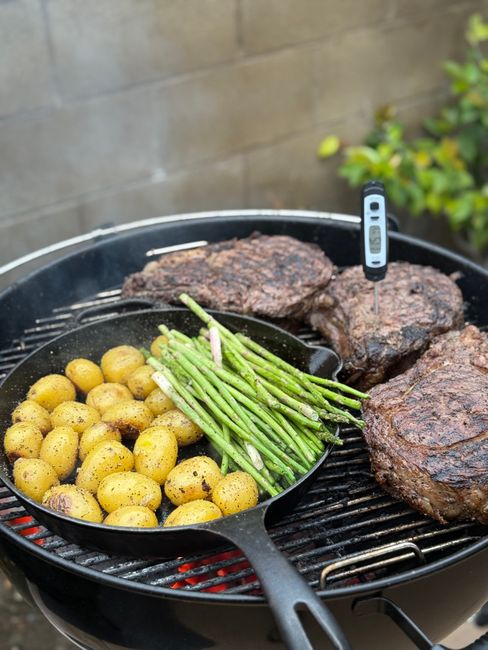
Why These Mistakes Happen
Thermometer errors are usually invisible until you cut open the food. A probe in the wrong spot gives a number that looks right — you'd only discover it was wrong if you measured the same spot twice from different angles and got two readings 15°F apart. Most home cooks don't do that, so errors compound silently over years of cooking.
The second category — reading errors — comes from impatience. A steak is hot, your hand is close to the grill, and waiting 4 seconds feels like a long time. You pull the probe at 2 seconds. The reading was still climbing. You recorded a temperature 5–10°F below actual. For a steak, this means overcooking (you think it's at 120°F, it's actually at 128°F — you leave it on the heat when it should come off). For chicken, this is a food safety issue — you think it's at 160°F, it's at 168°F, which is fine. The error direction varies; the remedy is the same: wait for the reading to stabilize.
Equipment You Need
| Tool | Why It Matters for Avoiding Mistakes |
|---|---|
| Digital instant-read (±1–2°F) | Dial thermometers take 15–20 seconds and can't be positioned accurately in thin cuts |
| Glass of ice water | Calibration check — 2 minutes of prep prevents all reading-accuracy mistakes |
| 70% isopropyl alcohol wipes | Between-protein cleaning; prevents cross-contamination |
Placement Mistakes
Mistake 1: Inserting the Probe Too Close to Bone
The problem: Bone conducts heat faster than muscle tissue. The area within 0.25–0.5 inches of bone reads 10–15°F hotter than the surrounding meat. A chicken thigh probe touching the bone might read 175°F while the nearby muscle is at 160°F — 5°F below the 165°F safe minimum per USDA food safety guidelines.
The fix: Insert the probe from the side of the thigh, angling the tip away from the bone. For chicken, go in from the outer face of the thigh toward the joint area, keeping the tip in muscle tissue. Verify by removing the probe and reinserting ¼ inch in a slightly different direction — if the reading changes by more than 3°F, you were near bone.
Mistake 2: Reading Only the Surface Temperature
The problem: Inserting the probe only 0.25–0.5 inches deep reads surface or near-surface temperature, which on an active grill or oven is 20–50°F hotter than the center. A steak that's 155°F at the surface can be 125°F at the center. You pull it thinking it's medium, and it's medium-rare — which is fine if that's what you wanted, but you didn't know that's what you were measuring.
The fix: Insert from the side, horizontally, so the probe tip reaches the geometric center of the thickest dimension. For a 1.5-inch steak: probe tip at 0.75 inches from the surface. For a whole chicken: probe tip 2–3 inches into the thigh muscle.
Mistake 3: Probe Tip Touching the Cooking Grate or Pan
The problem: If the probe tip touches a metal cooking surface (grill grate, cast iron pan, roasting rack), it reads the surface temperature of that metal — which is at cooking temperature, not food temperature. A grill grate at 400°F reads 400°F when touched; the brisket next to it is at 185°F. The reading looks like the food is done; it isn't.
The fix: Position the probe tip in the center of the meat, not near the edges where it might contact the cooking surface. Check for this specifically with burgers (thin patty, easy to punch through to the grate below) and fish fillets.
Mistake 4: Inserting from the Top on a Steak
The problem: Inserting the probe straight down into the top of a steak measures an average of temperatures from the hot surface to the cool center, along the length of the probe shaft. You don't get the center temperature — you get a blend. The result is always higher than the actual center temperature.
The fix: Insert horizontally from the narrow side (edge) of the steak. The probe tip ends up in the geometric center, and you're measuring only the center temperature.
Technique Mistakes
Mistake 5: Pulling the Probe Before the Reading Stabilizes
The problem: A digital instant-read needs 2–5 seconds to equilibrate to the meat's temperature. Pulling the probe while the number is still rising gives you an artificially low reading — the probe was still absorbing heat from the meat. You record 125°F; the steak was actually at 130°F. You put it back on the heat. It finishes at 140°F. Medium.
The fix: Wait until the displayed temperature stabilizes (stops changing) before reading. For an instant-read thermometer, that's typically 2–4 seconds after insertion. A still-rising number means wait; a stable number means read.
Mistake 6: Only Checking One Spot on Large Cuts
The problem: A 14-lb brisket has a 15–20°F temperature gradient from the thin end to the thick end of the flat. If you check only the thick center and it reads 200°F, the thick end is done. The thin end may already be at 210–215°F and past optimal. Conversely, checking only the thin end and getting 200°F means the thick center is still at 185–190°F.
The fix: Check 2–3 spots on any cut over 5 lbs: the thickest point, a point in the middle, and the thinnest section. The lowest reading is your guide. Use the brisket cook time calculator to plan your overall window, but confirm doneness with the thermometer, not the clock.
Mistake 7: Ignoring Carryover Cooking
The problem: Pulling a steak at 130°F thinking it'll serve at 130°F. In reality, the outer layers of the steak are at 160°F+ and continue transferring heat inward for 5–7 minutes after removal. The steak arrives at the table at 138–140°F — medium, not medium-rare. You didn't overcook it on the grill; you misunderstood the process.
The fix: Pull 5–7°F below your target temperature. For medium-rare (target 130–135°F final), pull at 123–125°F. Rest 5 minutes. The steak arrives at 130–133°F.

Calibration and Maintenance Mistakes
Mistake 8: Skipping Calibration Before First Use
The problem: Out-of-the-box thermometers can have factory calibration drift. A unit specced at ±1°F might arrive reading ±2.5°F. You don't know until you test. A $15 thermometer that reads 35°F in ice water has 3°F of error — not catastrophic, but significant for chicken near the 165°F safety threshold.
The fix: Ice water test before first use. Fill a glass with ice and water, stir 30 seconds, insert probe. Should read 32°F (±1–2°F acceptable). If it reads 35°F, account for that in your cooking: read 165°F + 3°F = target reading of 168°F on your thermometer for safe chicken temperature. Or use the offset/calibration function if your unit has one.
Mistake 9: Not Recalibrating After Dropping the Thermometer
The problem: A drop on the probe end can shift the sensor. Physically the thermometer looks fine. But it now reads 3–5°F off. You won't notice until you're systematically getting overcooked or undercooked results.
The fix: Any time you drop your thermometer, run the ice water test before the next cook. It takes 2 minutes. You'd rather know before the meal than during or after.
Mistake 10: Leaving Dead Batteries Inside the Unit
The problem: A dead CR2032 or AAA battery left inside a thermometer for weeks begins to leak. The alkaline electrolyte corrodes the battery contacts. The thermometer stops working or starts giving erratic readings. This is the most common cause of premature thermometer failure.
The fix: If you won't be cooking for more than 2–3 weeks, remove the battery. When the battery runs low (display dims or reads "LO"), replace immediately. Don't let it sit depleted.
Food Safety Mistakes
Mistake 11: Using the Same Probe on Different Proteins Without Cleaning
The problem: Probe goes from raw chicken into cooked beef. Raw chicken bacteria transfer to the beef probe insertion point. If the beef was below 140°F when checked (common for medium-rare steak), bacteria at the puncture site are at temperatures they can survive. Cross-contamination risk.
The fix: Wipe the probe with a 70% isopropyl alcohol prep pad between uses on different proteins. Keep a small pack at your grill station. It takes 5 seconds. See the chicken temperature guide for the full safety context around poultry handling.
Mistake 12: Treating Visual Doneness as Primary
The problem: Ground beef can be brown throughout at 140°F (safe) or 155°F (also safe) or at 145°F (below the 160°F USDA minimum for ground beef). Color indicates no food safety information. Chicken can be fully cooked and still pink near the bone, or it can be pink-free and undercooked. The color is not the indicator.
The fix: The thermometer is the primary doneness indicator. Visual cues are supplementary. A chicken breast that looks done but reads 158°F needs 2 more minutes. A burger that's brown throughout but reads 148°F needs more cooking. See USDA food safety guidance on color vs. temperature for the scientific basis.

Pro Tips: Getting It Right Every Time
Keep a written reference card at your grill. Target pull temperatures for each protein, written down, next to your grill. You shouldn't need to remember whether chicken pulls at 160°F or 163°F for carryover — you should be able to check. A laminated card costs $0 and eliminates memory errors at a moment when you're distracted by multiple things.
Check your thermometer monthly. Ice water test, 2 minutes, once a month. Keep a note of the date and reading. If it drifts, you know to account for it or replace the unit.
Store your thermometer with the probe protected. The probe tip is the sensor. Dropping probe-tip-first on a hard surface or storing it where it gets bent can shift calibration without visible damage. Use the protective sleeve that came with the thermometer.
Develop a habit of reading twice on important cooks. Insert, wait for stabilization, read, remove. Re-insert in the same spot, wait for stabilization, read again. Both readings should be within 1°F. If they're not, the probe position shifted between readings — take a third reading and average.
FAQ
Why does my thermometer give different readings in different spots?
Because the temperature genuinely is different in different spots. A large cut of meat has temperature gradients of 15–30°F across its dimensions. The correct reading is from the coldest spot — the geometric center of the thickest muscle mass, away from bone and fat. Check the coldest spot; if it's at safe temperature, everything warmer is also safe.
Can a meat thermometer be wrong?
Yes — from calibration drift, probe damage, incorrect placement, or reading before stabilization. Any of these produces an inaccurate reading. That's why calibration checks (ice water test) and correct placement technique are both important, and why the reading is only as good as the technique used to take it.
How do I avoid burning myself when using a thermometer?
A long probe (4–5 inches) and a stable hand angle minimizes hand proximity to heat. Insert from the side of the meat, not from above — a side insertion keeps your hand further from the grill surface. Hold briefly (2–5 seconds), get the reading, and remove. A thermometer with a rotating display that works at any probe angle means you don't need to contort your wrist to read the display while holding the probe over heat.
Does it matter if the thermometer is cold when I insert it?
Slightly. A room-temperature probe reaches equilibrium in 2–4 seconds. A probe pulled from a refrigerator drawer (40°F) might take 4–6 seconds to equilibrate. For all practical purposes, the effect is minor if you wait for the reading to stabilize before reading — which you should do regardless.
What does it mean when my thermometer reading keeps changing?
If the reading is rising: the probe is still equilibrating to the meat temperature — wait. If the reading fluctuates up and down: either the probe tip is near the edge of a temperature zone (move it slightly) or the battery is low. If the reading drops after stabilizing: you moved the probe position. Check for consistent stable reading in the same location.
How do I check if my thermometer is accurate?
Ice water test: 32°F target (±1–2°F acceptable). Boiling water test at sea level: 212°F. A thermometer that passes both tests is calibrated across the full range you'll use for cooking. A thermometer that fails one test may have a linear error (reads consistently high or low) that you can account for, or a non-linear error (reads wrong at specific temperatures) that makes it unreliable.
Recommended by Titan Grillers
IP67 Waterproof Digital Meat Thermometer
Reads in 2–3 seconds · Backlit LCD · Built-in magnet · Free returns
Free BBQ Calculators
Use our free tools to nail your cook times, temperatures, and quantities every time.
You Might Also Like


Join the Grill Masters Club
Get exclusive recipes, techniques and special offers on our premium meat thermometers.