Proper Thermometer Placement: Where to Insert for Accurate Readings
The blog post covers proper thermometer placement techniques for various scenarios, including different cuts of meat, poultry, fish, baked goods, and medical uses. It explains why placement matters for accuracy and food safety, details common mistakes to avoid, and provides specific guidance for different food types. The content naturally incorporates the TITAN GRILLERS brand and product links while maintaining a helpful, informative tone throughout.

The probe tip reads the temperature. Not the shaft, not the housing — the very tip. Insert it into the thickest part of the meat, centered away from bone, fat pockets, and the cooking surface. Wait for the reading to stabilize. Those three rules cover 90% of scenarios. The rest is knowing why they exist and what goes wrong when you ignore them.
Why Placement Matters
Temperature varies dramatically across a piece of meat. The surface of a steak on a 500°F grill is at 350–400°F while the center is at 115°F. Near bone, temperatures run 10–15°F hotter than surrounding muscle because bone conducts heat differently. Fat pockets act as insulation and read 5–10°F colder. The grill grate itself is at cooking temperature — touching it with your probe reads grill temperature, not meat temperature.
In all of these cases, you get a reading. The number looks plausible. And it's wrong — sometimes by 15–20°F. A 15°F error on chicken means the difference between a safe 165°F reading and an actual temperature of 150°F. That's a food safety failure, and it's invisible without understanding why placement went wrong.
Equipment You Need
| Thermometer Type | Probe Length | Best Use Case |
|---|---|---|
| Instant-read digital | 4–5 inches | Steaks, chops, chicken pieces, burgers |
| Leave-in probe | 4–6 inches | Roasts, whole birds, smoked meats |
| Wireless probe | 3–4 inches (varies) | Overnight smokes, long cooks |
For most home cooking, a 4–5 inch probe handles every scenario. Shorter probes (under 3.5 inches) can't reach the center of a 10-lb whole chicken or a thick pork shoulder without forcing you to hold the handle dangerously close to the heat. If your current thermometer has a short probe and you're struggling with placement on large cuts, that's likely the root cause.
Step-by-Step: The General Rules
Rule 1: Identify the Thickest Part of the Meat
The thickest part is always the coldest spot — heat takes longer to reach the center of a thick section than a thin one. If the thickest part is at safe temperature, everything thinner is also at safe temperature. Start there. On a chicken breast, that's the widest, deepest point near the sternum attachment. On a brisket, that's the center of the flat.
Rule 2: Avoid Bone, Fat, and Cooking Surfaces
Bone reads 10–15°F hotter than surrounding muscle. A chicken thigh reading 165°F near the bone might be at 152°F in the muscle 0.5 inches away. Fat pockets insulate and read colder than muscle. The cooking surface (grill grate, oven rack, pan) is at cooking temperature — 300–500°F depending on method. If the probe tip touches any of these three, your reading is meaningless.
Rule 3: Insert Horizontally into the Center
Go in from the side or the end of the cut — not straight down from the top. Coming down from the top on a steak places the probe tip at the surface after it passes through the meat, which reads surface temperature. Coming in from the side horizontally allows you to position the tip precisely in the geometric center.
Rule 4: Wait for the Reading to Stabilize
A quality instant-read stabilizes in 2–4 seconds. A budget unit takes 4–8 seconds. Wait until the number stops changing. A reading that's still climbing is the probe equilibrating to the surrounding temperature — not the actual meat temperature yet. Pulling the probe while the number is still moving gives you an artificially low reading.
Rule 5: Check Two Spots on Large Cuts
A 14-lb brisket can have a 10–15°F temperature difference between two spots on the flat. The lowest temperature is the relevant one for food safety. On a whole turkey, check both the breast and the thigh — they're done at different times. The thigh is always cooler; the thigh is always the one you're verifying.
Steaks and Chops
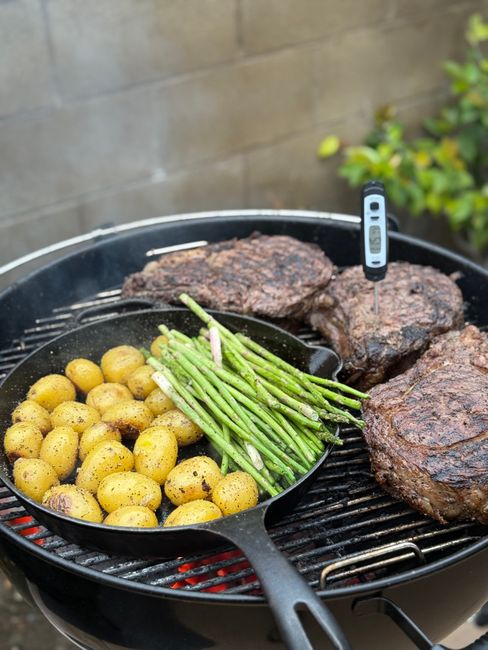
Insert from the narrow side (the edge) of the steak horizontally through the center, so the probe tip ends up in the geometric middle of the thickest point. For a 1.5-inch ribeye, that's approximately 0.75 inches from either flat side. For a pork chop with a bone, angle to keep the tip away from bone on both sides.
For a burger, insert from the side through the center — not straight down from the top where you'll likely hit the grill grate on the way through. The probe tip should be in the center of the patty, not touching the grate below.
Temperature targets: steak medium-rare 130–135°F, pork chops 145°F minimum per USDA safe minimum temperatures. See our dry rub calculator for seasoning quantities by cut weight.
Whole Chicken and Turkey
For a whole chicken or turkey, insert the probe into the thickest part of the thigh, not touching the thigh bone. The thigh is always the last part to reach safe temperature — if the thigh is at 165°F, everything else is done. Don't rely on breast temperature alone; the breast reaches safe temperature faster and a 165°F breast reading means nothing about thigh safety.
Insertion angle: go in from the side of the thigh, directing the probe tip toward the joint area where the thigh meets the body. The joint area is the deepest muscle mass and the last to heat. Avoid the hip joint (bone) by going in from the outer face of the thigh rather than between the thigh and body cavity.
For a whole turkey, also check the stuffing temperature if you stuff — stuffing must reach 165°F independently. Insert the probe into the center of the cavity stuffing. Use the chicken temperature guide for complete poultry temperature targets.

Roasts and BBQ Cuts
For a beef roast (prime rib, round, chuck), insert the probe into the geometric center of the cut, horizontally from the narrow end if possible. Avoid the fat cap (it insulates), the bone (runs hotter), and any surface near the roasting pan (reads pan/oven ambient temperature).
For brisket: the flat has uneven thickness — the thin end is done well before the thick end. Insert into the thickest point of the flat, approximately 2–3 inches deep. The point (the fattier, thicker section) runs cooler and fattier — it's more forgiving, but the flat is your accuracy reference. Check it: at 200–205°F, the probe should slide in with minimal resistance — that probe-tender feel confirms what the number tells you. Use our brisket cook time calculator for timing the cook.
For pork shoulder: multiple muscle groups with fat seams. Insert 2–3 inches into the largest muscle mass away from the bone and visible fat seams. Target 195–203°F for pull-apart texture. Pork shoulder timing guide here.
Ground Meat and Fish
Ground meat (burgers, meatloaf, meatballs): insert from the side into the thickest dimension so the tip is centered. Ground meat must reach 160°F — unlike whole muscle cuts where bacteria stays on the surface, grinding distributes surface bacteria throughout the patty. There is no medium-rare for ground beef from a food safety standpoint, regardless of the restaurant's menu.
Fish: insert at an angle into the thickest part of the fillet. Fish is done at 130–145°F depending on species and preference, but the window is narrow — 10°F separates perfectly cooked from overcooked. Quick placement and a fast thermometer matter more for fish than for any other protein.
Common Placement Mistakes
Reading temperature near the surface. The surface of a steak is 30–50°F hotter than the center during active cooking. Even a probe inserted only ¼ inch from the surface will read significantly higher than the true center temperature. Insert deep enough that the tip is genuinely in the center of the thickest point.
Touching bone on poultry. The most common source of falsely high chicken readings. The thigh bone conducts heat faster than muscle and can read 10–15°F above the surrounding tissue. A chicken thigh reading 165°F near the bone might be 152°F in the muscle 0.5 inches away from bone. Stay away from the bone.
Inserting from the top of a steak. Inserting straight down from the top of a steak places the probe shaft vertically through the meat. The reading you get is the average temperature along the probe shaft — which mixes surface (hot) and center (cool) measurements. You won't get an accurate center reading. Always go in from the side.
Not waiting for the number to stabilize. A thermometer inserted and pulled in 1–2 seconds before the reading stabilizes gives you the temperature the probe entered the meat at, not the meat's actual temperature. Wait 2–4 seconds (instant-read) or until the number holds steady.
Single reading on a large cut. One reading from the center of a 15-lb brisket doesn't tell you the full picture. The flat's thin end, the thick end, and the point are all at different temperatures. Check at least two spots and use the lowest reading as your guide.

FAQ
Where do you put a thermometer in a chicken?
Into the thickest part of the thigh, not touching the thigh bone. Insert from the outer side of the thigh angling toward the joint area. This is the coldest spot in the bird — if the thigh reads 165°F, the cook is done. Don't check only the breast; it reaches temperature faster than the thigh and doesn't indicate overall doneness.
Why does my steak read different temperatures in different spots?
Because it is different temperatures in different spots. The surface of a steak can be 50°F hotter than the center while actively cooking. Muscle fibers near the bone conduct heat differently. The geometry of the cut creates hot and cool zones. For practical purposes: check the thickest part, away from bone, with the probe tip in the center. That's the number that matters.
How far should the probe go into the meat?
Far enough that the tip is in the geometric center of the thickest part. For a 1.5-inch steak inserted from the side, that's 0.75 inches in. For a 10-lb turkey thigh, it's 2–3 inches in. The goal is to position the sensor tip at the coldest point in the cut — the center of the thickest muscle mass.
Can I leave a thermometer in the meat while it cooks?
Only if it's a leave-in probe thermometer designed for that purpose. The display unit of a standard instant-read isn't rated for sustained heat exposure. Leave-in probes have heat-rated cables and are designed to monitor throughout the cook. Using an instant-read as a leave-in will damage the display and potentially give inaccurate readings.
Why do I get different readings when I check the same steak twice?
Different insertion points hit different temperature zones. If you hit near the surface on the first check and the center on the second, you'll see 10–20°F variation. Insert consistently into the same location for comparison reads. Also ensure the reading has stabilized before reading — a rising number means the probe is still equilibrating.
Does the angle of probe insertion matter?
Yes. Inserting horizontally from the side allows you to target the center of the meat precisely. Inserting from the top at an angle averages temperatures across the insertion path. For steaks, always insert from the side. For whole birds and roasts, use whatever angle positions the tip at the coldest, deepest muscle mass.
Recommended by Titan Grillers
IP67 Waterproof Digital Meat Thermometer
Reads in 2–3 seconds · Backlit LCD · Built-in magnet · Free returns


