Digital vs. Analog: Which Budget Thermometer Type Is Best? (2025 Comparison Guide)
This comprehensive comparison guide helps readers choose between digital and analog thermometers by examining accuracy, price, durability, and usability of budget options. The article provides specific recommendations in both categories, with special focus on cooking applications. It naturally incorporates TITAN GRILLERS products while providing genuinely helpful advice for consumers making purchasing decisions in 2025.


Digital thermometers win for BBQ and cooking. Faster reads (3–5 seconds vs. 20–30 seconds), better accuracy (±1°F vs. ±3–5°F), and they don't require a manual calibration wrench. The only scenario where analog holds up is as a leave-in oven roasting thermometer where a dial face is convenient and speed doesn't matter.
Quick Verdict
| Type | Price | Best For | Read Speed | Accuracy |
|---|---|---|---|---|
| Budget digital | $15–25 | Casual grilling, everyday cooking | 3–5 sec | ±1–2°F |
| Mid digital | $35–60 | Regular grilling, smoking | 2–3 sec | ±0.9–1°F |
| Premium digital | $100+ | Serious BBQ, candy, frying | 1 sec | ±0.7°F |
| Analog dial | $8–20 | Leave-in roasting, presentation | 20–30 sec | ±3–5°F |
What to Look For
Read Speed
For grilling, the lid is open while you check temperature. Every extra second costs heat. 3–5 seconds is acceptable. 10+ seconds is frustrating. 20–30 seconds (typical analog) means the grill temperature has dropped significantly by the time you have a reading.
Accuracy
For chicken safety (165°F minimum), ±1°F is ideal; ±2°F is the maximum acceptable margin. Analog thermometers at ±3–5°F mean you might pull chicken at 162°F thinking it's 165°F. That's not snobbishness about decimal places — it's the math of the safety threshold.
Display
Large, backlit, readable at arm's length in bright sunlight. If you're squinting to see a number while holding a cut of meat in one hand and tongs in the other, the display design failed you.
Durability
Look for IP65 or higher water resistance for grilling. The probe will encounter steam, splatter, and rain. A probe rated "splash-resistant only" will fail sooner in a BBQ environment than a properly sealed unit.
Digital Thermometers: The Case For
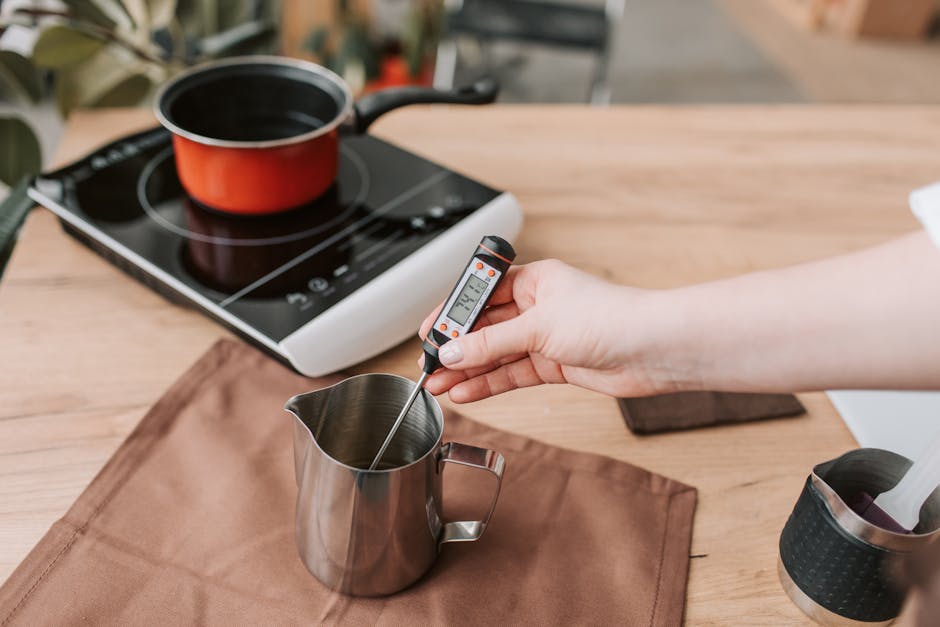
Digital thermometers use a thermocouple or thermistor at the probe tip — an electronic component whose resistance changes with temperature. The main unit converts that resistance to a temperature reading and displays it digitally.
The advantages over analog are measurable:
- Read time: 3–5 seconds vs. 20–30 seconds for analog bimetallic
- Accuracy: ±1°F for most digitals vs. ±3–5°F for most analog
- Probe tip size: thermocouple probe tips are thin (1–2mm), leaving almost no hole in the meat
- Features: alarms, Bluetooth, logging, preset targets — none of which analog can offer
- Calibration: most digitals have digital offset calibration; analog requires a physical wrench adjustment
Budget digital options (Alpha Grillers, Kizen, $15–25) genuinely read in 3–5 seconds and hit ±1–2°F accuracy. For everyday cooking including grilling and roasting, these compete with analog at any price point.
Analog Thermometers: The Case For (and Against)
Analog bimetallic thermometers use a coiled metal strip that expands and contracts with temperature, moving a dial needle. They're simple, require no batteries, and can be left in the oven indefinitely (as leave-in roasting thermometers).
The case against in most scenarios:
- 20–30 second read time makes them impractical for quick grill checks
- ±3–5°F typical accuracy — fine for a pot roast, concerning for chicken
- Dial faces are hard to read at angles — you often have to crouch or lean to see the needle directly
- Can't set temperature alarms
- Require physical recalibration with a wrench (not a huge deal, but more friction)
Where analog still makes sense: inexpensive leave-in oven thermometers for baking, where you're monitoring ambient oven temp rather than food temp, and speed doesn't matter. Also: certain presentations (a dial thermometer inserted in a roast at a dinner table looks better than a digital unit) where aesthetics matter more than precision.
Comparison Matrix
| Feature | Digital | Analog |
|---|---|---|
| Read speed | 3–5 sec (budget) to 1 sec (premium) | 20–30 sec |
| Typical accuracy | ±1°F | ±3–5°F |
| Battery required | Yes | No |
| Leave-in capable | Yes (probe models) | Yes (oven safe designs) |
| Alarms | Many models | No |
| Calibration | Digital offset (many models) | Physical wrench adjustment |
| Probe tip size | 1–2mm (thin) | 3–6mm (thicker) |
| Price range | $15–200 | $8–30 |
When Analog Makes Sense
Analog wins in exactly two scenarios:
1. Leave-in oven roasting thermometer: If you want a thermometer that stays in a roast while it's in the oven and you can read the dial through the oven door — a $12 analog dial thermometer works perfectly. You don't need 3-second reads for a 3-hour roast. Speed is irrelevant, and the accuracy margin of ±3°F on a beef roast targeted at 135°F is acceptable (you'd pull at 128–130°F to land at 133–135°F after carryover).
2. No batteries available: Analog works with no electronics. In a survival or camping scenario, this matters. At a backyard cookout, it doesn't — you have phone chargers.
For everything else — grilling, BBQ, smoked meats, chicken safety verification — digital wins on every metric that matters.
The USDA food safety guidelines specify minimum temperatures by protein type. The ±3–5°F margin on analog thermometers means you need to cook to 168–170°F on a dial thermometer to be confident you've actually hit 165°F. On a digital, 165°F is 165°F ± 1°F.
Common Buying Mistakes
Buying an analog dial thermometer because it "looks professional." Dial thermometers look like something a professional would use because butchers and restaurant cooks historically used them. They still do — in specific contexts where leave-in monitoring at low precision is fine. For home grilling and BBQ, they're a step backward from a $15 digital unit.
Assuming digital means expensive. A $15–16 Alpha Grillers digital instant-read is more accurate and faster than any analog thermometer at any price. The entry point for quality digital is lower than most people assume.
Buying an analog oven thermometer and then using it for quick-check grilling. An oven thermometer is calibrated for oven temperatures and designed for slow reads. If someone grabs a dial thermometer to quickly check a steak on the grill, they're going to hold the lid open for 20–30 seconds, lose all their grill heat, and get an inaccurate reading anyway.
Confusing "dial thermometer" with "instant-read." These are not the same. Instant-reads exist in both digital (fast, accurate) and analog (slow, less accurate) versions. The term "instant-read" technically applies to both — but real instant-read speed (3–5 seconds) is only achieved by digital models. An analog "instant-read" is marketing.
FAQ
Is there any accuracy difference between budget digital and premium digital?
Yes, but it's smaller than the price difference suggests. A $15 Alpha Grillers typically reads ±1–1.5°F. A $105 Thermapen ONE reads ±0.7°F. That 0.3–0.8°F difference matters in precise candy work and sous vide. For BBQ and grilling, it's almost always irrelevant. The real premium justification is read speed (1 second vs. 3–5 seconds) and build quality over time.
Can I use a dial thermometer to check if chicken is done?
Technically yes, but the 20–30 second read time and ±3–5°F accuracy make it a poor choice. You'll hold the grill or oven open for half a minute, and the reading may be 3°F off anyway. A $15 digital does this job better in every measurable way.
Do digital thermometers require calibration?
They should be checked but many can't be manually recalibrated unless they have a digital offset setting. Check in ice water quarterly. If a digital reads 29°F or 35°F in ice water, it needs replacement or offset adjustment. Budget analog thermometers can often be recalibrated with a wrench — but they drift back out of calibration faster than quality digitals.
What type of thermometer do professional pitmasters use?
The Thermapen ONE is the most common choice among competition BBQ cooks and serious home pitmasters. It's 1-second read, ±0.7°F, IP67 waterproof, and $105. For ambient monitoring during long smokes, most use ThermoWorks Smoke X2 or X4 with multiple probes. Budget pitmasters use ThermoPro TP25 — $50 for 4 probes and acceptable accuracy.
Is a bi-metallic analog probe the same as a dial thermometer?
Yes — bimetallic, dial thermometer, and analog thermometer all refer to the same type. The coiled bimetallic strip is the sensing mechanism; the dial is the display. They're the same product with different names depending on the context.
Should I get a digital with or without a Bluetooth app?
For a simple instant-read, no app needed. Apps add complexity, battery drain, and a dependency on your phone. For a leave-in probe thermometer where you want to monitor remotely during a long cook, app integration is genuinely useful. Match the feature to the use case.
Recommended by Titan Grillers
IP67 Waterproof Digital Meat Thermometer
Reads in 2–3 seconds · Backlit LCD · Built-in magnet · Free returns
Free BBQ Calculators
Use our free tools to nail your cook times, temperatures, and quantities every time.
You Might Also Like


Join the Grill Masters Club
Get exclusive recipes, techniques and special offers on our premium meat thermometers.